

Table of Contents
- What to Expect From a Steel Roof Near Me: Styles and Profiles
- Metal Roofing Cost Per Square Foot: What Drives Your Quote
- Steel Roof Lifespan vs Asphalt Shingles: A 40-Year Comparison
- The Metal Roof Installation Process, Step by Step
- DIY vs. Professional Installation: Risks That Outweigh the Savings
- Permits, Building Codes, and Choosing a Steel Roof Near Me
- Frequently Asked Questions
Last Updated: September 11, 2026
What to Expect From a Steel Roof Near Me: Styles and Profiles
Searching for a steel roof in Boise, Idaho, usually starts the same way: a homeowner notices granule loss on aging shingles, a property manager gets a leak report, and the decision becomes urgent. Steel is the material most people land on after comparing options, and it solves the problems asphalt keeps creating. We install residential and commercial systems across Southwestern Idaho and Eastern Oregon, and steel is a popular roofing category.
A steel roof is a roofing system made from formed steel panels coated to resist corrosion, installed over a moisture barrier and fastened to the roof deck. Two profiles dominate: standing seam, where raised seams hide the fasteners and panels float with thermal movement, and corrugated or ribbed panels, where exposed fasteners run through the panel face. Standing seam suits lower roof pitches and cleaner sightlines. Ribbed panels cost less and work well on shops, barns, and outbuildings where coverage matters more than appearance.
Gauge thickness decides how the panel performs under foot traffic and hail. Most residential panels run between 24 and 26 gauge; heavier gauges resist denting better but cost more. Coatings matter just as much: galvanized steel carries a zinc layer, while painted systems add a barrier against corrosion and fade.
Metal Roofing Alliance guidance on panel profiles and finishes
Curb appeal matters too: panel profiles, colors, and finishes change how a house reads from the street, which counts at resale. The trade-off is that steel amplifies rain noise unless installed over solid decking with proper underlayment, a detail cheap installs skip.
Metal Roofing Cost Per Square Foot: What Drives Your Quote
Metal roofing cost per square foot is not a single number, and any contractor who quotes one without seeing your roof is guessing. Pricing depends on panel profile, gauge, coating, pitch, penetrations, and how much of the existing roof must come off first.
What actually moves your quote:
- Panel type: standing seam costs more than ribbed or corrugated panels because of the forming and seaming labor.
- Gauge and coating: heavier steel and premium paint systems raise material cost but extend service life.
- Roof complexity: valleys, dormers, chimneys, and skylights multiply flashing and labor hours.
- Tear-off: removing old shingles adds disposal and labor. Sometimes a steel system can go over existing decking, sometimes it cannot.
- Access and pitch: steep roofs and tight lots slow crews down.
Because pricing varies this much, we give detailed quotes with project timelines rather than a flat rate over the phone. A free estimate should itemize materials, labor, tear-off, and accessories. If a competing bid comes in dramatically lower, ask what it excludes, as underlayment, flashing, ventilation, or permit fees are common omissions.
Steel Roof Lifespan vs Asphalt Shingles: A 40-Year Comparison
Steel roof lifespan vs asphalt shingles is where the math gets interesting, and where most sales pitches get vague. Instead of one lifespan number, break the comparison into the four costs that repeat over a 40-year window: material, tear-off and disposal, labor, and maintenance.
Start with replacement cycles. Asphalt shingles are commonly rated on – 30- 50 year (or “Limited Lifetime”) timelines, but that assumes ideal ventilation and moderate weather. In hail-prone corridors and high-wind zones, real-world service life often lands closer to 12 to 18 years, so a 40-year window can contain two or even three full replacement cycles, each with its own tear-off, disposal, deck repair, and labor bill.
A coated steel roof changes that curve. Most residential steel systems are expected to serve 40 to 70 years depending on gauge, coating, and climate, with manufacturer warranties measured in decades. The practical result is one installation followed by maintenance, instead of two or three installations followed by maintenance.
Here is how the cost categories stack up over the same 40 years:
- Material: asphalt is cheaper per square on day one; steel costs more upfront but is bought once.
- Tear-off and disposal: asphalt pays this cost every cycle; steel pays it once, at installation.
- Labor: asphalt multiplies labor across cycles; steel concentrates it in a single project.
- Maintenance: asphalt needs periodic granule loss checks, flashing repair, and eventual patching; steel needs fastener and seam inspection, plus occasional touch-up at cut edges.
- Interior risk: every asphalt replacement cycle is another chance for a missed flashing detail or a deck leak; steel removes those repeat exposure events.
Divided over 40 years, steel frequently lands lower per year even though the initial invoice is larger. The crossover point depends on your climate, roof complexity, and how long you plan to own the home: a homeowner who sells in five years may never reach it, while one who stays put usually does.
Longevity is not automatic, though, it depends on installation quality more than panel marketing. Corrosion protection fails first at cut edges and fastener points, which is why manufacturer-certified installation matters. Ventilation underneath the panels controls condensation and heat; a steel roof over a poorly vented attic can trap moisture and rust from the underside, the failure mode most homeowners never see coming.
- Asphalt: lower upfront cost, shorter life, repeat replacement cycles, repeat tear-off costs
- Steel: higher upfront cost, longer life, one installation with maintenance, single tear-off event
- Both: performance depends on underlayment, flashing, ventilation, and installation quality
Metal Roofing Alliance guidance on metal roof service life and warranties
The Metal Roof Installation Process, Step by Step
The metal roof installation process follows a predictable sequence, and knowing it helps you judge whether a crew is cutting corners.
- Inspection and measurement. The contractor checks deck condition, roof pitch, and structural integrity, then measures for custom fabrication of panels and trim.
- Tear-off or prep. Old roofing comes off, or existing decking is prepped if the system can go over it.
- Underlayment and moisture barrier. A synthetic underlayment or ice-and-water membrane goes down over the deck. This is your real defense against leaks.
- Flashing and trim. Valley flashing, drip edge, and penetration boots are installed before panels, so water never runs behind the steel.
- Panel installation. Panels are fastened to the deck. Standing seam panels clip and seam; ribbed panels fasten through the face with gasketed fasteners.
- Ridge, hip, and closure. Ridge caps and closures seal the system and let it vent.
- Final inspection. Fasteners, seams, and flashing get checked before the crew leaves.
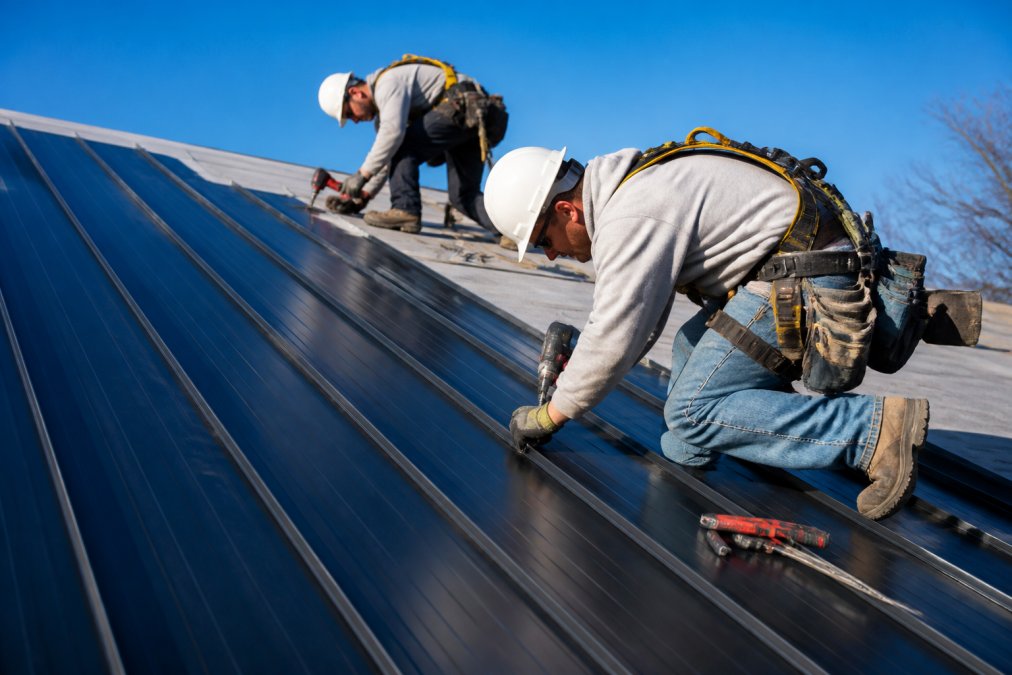
Timelines depend on roof size and complexity: a straightforward residential replacement moves faster than a commercial roof with multiple penetrations and HVAC curbs.
DIY vs. Professional Installation: Risks That Outweigh the Savings
DIY steel roofing looks tempting because the material is available at any building supply counter and the panels are not complicated to handle on the ground. The risks show up after the first hard rain, in specific, predictable places. Here is an honest look at where DIY works, where it fails, and why.
The failure mechanisms, in order of how often they appear:
- Panel layout errors. Steel panels are cut to length and cannot be stretched. If the first panel is set out of square, every subsequent panel inherits the error, and the last panel on the roof will not close cleanly. Fixing it means pulling panels and starting over, which is when DIY budgets collapse.
- Improper flashing. Water has to be directed over the steel, not behind it. Valley flashing, sidewall flashing, and penetration boots are where DIY installs leak first, because the details require bending and layering that is not obvious from a video.
- Fastener torque. Fasteners driven too tight crush the neoprene gasket and create a path for water. Driven too loose, they back out under thermal cycling. The correct torque is a feel, not a number, and it is learned on roofs, not in a driveway.
- Cut edge treatment. Every field cut exposes bare steel. Without proper touch-up, those edges are where corrosion begins, often within a few seasons.
- Ventilation design. Steel roofs need intake and exhaust balanced just like any other roof. A DIY install that seals the ridge without planning intake can trap moisture and rust the panels from underneath.
The safety problem is not theoretical. Steel panels are long, slick when wet or dusty, and awkward to carry on a pitched roof. Falls remain the leading cause of serious injury in roofing work. Professional crews work in harnesses anchored to the structure and stage panels with lifts and brackets rather than carrying them up ladders.
The warranty problem is contractual, not cosmetic. Many steel panel manufacturers require installation by a certified or approved contractor for finish and weathertightness warranties to remain valid. A DIY install does not just risk leaks; it can void the protection you paid for in the material price.
The code problem is the one most homeowners miss. Roof replacement typically requires a permit, and inspections cover fastening schedules, flashing details, and sometimes wind uplift ratings. Skipping the permit creates a disclosure problem at resale and a coverage problem after storm damage, since insurers can question unpermitted work.
Where DIY makes sense:
- Detached sheds and outbuildings with low pitch and no penetrations
- Simple gable roofs with no valleys, dormers, or chimneys
- Structures where a leak would not damage living space or stored valuables
- Homeowners with prior metal roofing experience and proper fall protection
Where it does not:
- Any roof over living space
- Roofs with valleys, dormers, skylights, or multiple penetrations
- Steep pitches where fall risk rises sharply
- Projects where a manufacturer warranty is part of the value proposition
- Any project in a high-wind or heavy-snow jurisdiction with strict fastening requirements
|
Factor |
DIY Install |
Professional Install |
|---|---|---|
|
Flashing and waterproofing |
High leak risk at valleys and penetrations |
Sealed, layered, and inspected |
|
Warranty coverage |
Often voided by manufacturer terms |
Manufacturer-certified |
|
Safety risk |
Significant fall hazard, no harness anchor |
Harnessed crews, staged panels |
|
Permit and inspection |
Frequently skipped, resale risk |
Pulled and inspected |
|
Time to complete |
Weeks of weekends, weather-dependent |
Days, scheduled |
|
Cost per year of service |
Higher after rework and voided warranty |
Lower over roof life |
Permits, Building Codes, and Choosing a Steel Roof Near Me
Local building code and permit requirements vary by jurisdiction, and skipping them creates problems at resale and after storm damage. Most areas require a permit for roof replacement, and inspectors check fastening schedules, flashing details, and sometimes wind uplift ratings. Snow load capacity matters in mountain-adjacent areas, and fire resistance ratings matter near wildland interfaces.
Before you hire, verify licensing and insurance. In Idaho, roofing contractors register with the state contractor board; in Oregon, they license through the state construction contractors board. Ask for the registration number, a certificate of insurance, and confirmation the crew is covered. A contractor who hesitates on any of these is a contractor to walk away from.
This is where the “near me” part of your search pays off. A local contractor knows your jurisdiction’s permit process, your typical snow and wind loads, and which inspections your roof will face. All County Roofing Inc. handles permitting coordination as part of the project and provides professional roof certifications for lenders and insurance when a sale or claim requires documentation.
Idaho Division of Occupational and Professional Licenses contractor registration
Frequently Asked Questions
What is the biggest problem with metal roofs?
The most common complaint is noise during rain or hail, though proper underlayment and solid sheathing reduce this significantly. Oil canning, a wavy appearance on flat panel sections, is another issue that shows up when panels are too thin or fasteners are overtightened. Both problems trace back to installation quality, which is why hiring an experienced roofing contractor matters more than the panel brand itself.
Is it cheaper to put a metal roof or shingles?
Asphalt shingles cost less upfront, but a steel roof typically lasts two to three times longer, so the cost per year of service often favors steel. Metal roofing cost per square foot runs higher than asphalt, yet you avoid a second or third tear-off and replacement over the same period. Ask for a quote that shows both the upfront price and the expected lifespan so you can compare fairly.
How long does a professionally installed steel roof typically last?
A steel roof installed by a certified contractor commonly lasts 40 to 70 years, depending on gauge thickness, protective coating, and local weather exposure. Asphalt shingles in the same climate usually need replacement every 15 to 25 years. The gap matters most for homeowners planning to stay in place long term, since it can eliminate one or two full roof replacements.
Does a steel roof increase the resale value of a property?
Metal roofing can be a value-adding upgrade because buyers often recognize the durability and lower maintenance. A steel roof can also improve curb appeal with modern panel profiles and color options. Exact resale impact varies by market and home style, so ask a local contractor or appraiser how metal roofing is valued in your area before you commit.


