

Table of Contents
- What Roofing Service Actually Covers
- Finding a Commercial Roofer Near Me: What to Check First
- Signs of Commercial Roof Failure You Should Not Ignore
- A Roof Maintenance Checklist for Property Managers
- Repair or Replace? How to Decide
- How Roofing Estimates and Insurance Claims Work
- Frequently Asked Questions
Last Updated: September 16, 2026
What Roofing Service Actually Covers
Roofing service is the full scope of professional work performed on a roof after installation: inspections, repairs, replacements, maintenance, and emergency response. At All County Roofing Inc., we treat it as one continuous relationship rather than a series of one-off jobs, because that is how roofs fail: slowly, then suddenly.
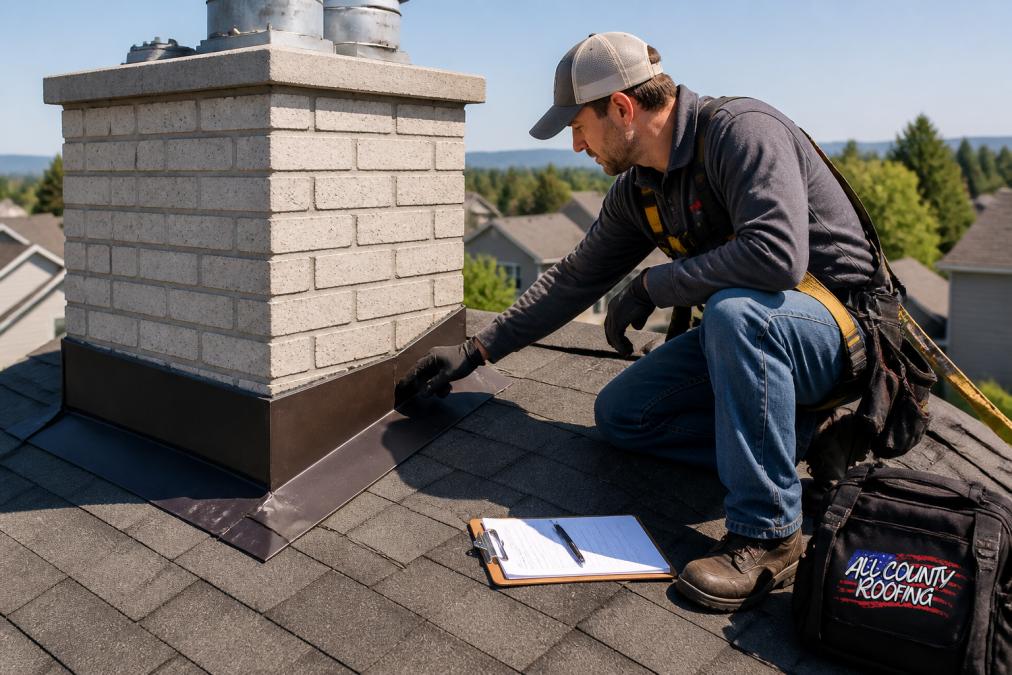
Repairs, Replacements, and Everything Between
Repairs address isolated failures: a cracked flashing detail, a few lifted shingles, a punctured membrane. Replacements address systems at the end of their service life. Between those poles sit the services that protect a building long-term: leak detection, roof coating, waterproofing, flashing repair, ventilation correction, and scheduled maintenance.
Residential and Commercial Work Are Not the Same Job
Residential roofing usually means steep-slope assemblies, asphalt shingles, tile, or metal, over a pitched deck that sheds water by gravity. Commercial roofing is a different discipline: flat and low-slope systems rely on continuous membrane and seam integrity rather than pitch, and single-ply systems like TPO and PVC are common.
Finding a Commercial Roofer Near Me: What to Check First
When you search for a commercial roofer near me, the results look similar and the websites sound identical. The differences that matter are documented, not advertised. Verify four things before taking a bid seriously:
- Licensing and insurance. Ask for the license number and confirm it is active. A legitimate contractor carries general liability and workers’ compensation coverage and will provide certificates on request.
- Manufacturer authorization. For TPO and PVC systems, manufacturer-certified installation is what makes enhanced warranties available at all. Without it, you may be limited to a basic materials warranty.
- Commercial experience you can see. Ask how many flat-roof projects they completed in the last year and whether they can walk you through a comparable building.
- Written scope and timeline. A roofing estimate should name the system, the attachment method, the insulation, and the schedule. Vague line items hide change orders.
Signs of Commercial Roof Failure You Should Not Ignore
The clearest signs of commercial roof failure are interior staining, ponding water that lingers more than 48 hours after rain, blisters or wrinkles in the membrane, and failed seam or flashing details. Catching them early is the difference between a targeted repair and a full replacement.
Watch for these indicators during routine walkthroughs:
- Ponding water signals inadequate drainage or slope, and it accelerates membrane breakdown.
- Blistering and ridges mean moisture is trapped inside the assembly.
- Open seams and flashing separation are the most common entry points on single-ply systems.
- Interior ceiling stains or rusted fasteners confirm water is already inside the building envelope.
- Vegetation in gutters and drains causes backups that damage the roof edge and fascia.
A Roof Maintenance Checklist for Property Managers
A roof maintenance checklist for property managers should run on a seasonal cycle, not a calendar reminder you ignore. Preventative maintenance is the cheapest line item in any roofing budget, and the one most often cut. The checklist below covers the physical tasks, but the part most managers skip, and the part that pays off when a storm hits, is the documentation.
Spring
- Clear all drains, scuppers, and gutters of debris
- Inspect membrane seams and flashing after freeze-thaw cycles
- Check rooftop equipment curbs and penetrations for sealant failure
- Photograph every roof section with a date stamp and file it
Summer
- Walk the roof after the first major storm of the season
- Photograph and log any new blisters, punctures, or ponding areas
- Confirm HVAC contractors are using protection boards when servicing units
- Note the date, time, and weather event for any new damage
Fall
- Remove leaves before the rainy season begins
- Re-check drainage slope and confirm water flows to drains
- Schedule any repairs found during the year before weather closes in
- Update your maintenance log with the season’s findings
Winter
- Inspect after snow events for ice damming and drift loading
- Watch interior ceilings for new staining
- Document everything for your insurance file
- Keep a running list of deferred repairs for spring
Building the Paper Trail That Pays Off
What most property managers miss is the paper trail. A dated photo log turns a disputed claim into a documented one. When you file a storm damage claim, the adjuster scopes the loss against the policy, your job is to make that scope easy to verify.
A practical documentation routine looks like this:
- Photograph the roof at every inspection with a date stamp, from the same angles each time, so change over seasons is visible.
- Log every repair and every contractor visit, who, when, what was done, and what was found.
- Keep receipts and warranties in one file, including the manufacturer’s warranty documents and any contractor workmanship warranty.
- Note weather events that could have caused damage, with the date and a description, before you forget them.
- Store it all off-site or in the cloud so a flooded office does not take your roof records with it.
Navigating an Insurance Claim
Insurance claims follow a defined sequence; knowing it in advance keeps you from being surprised at each step.
- Report the loss promptly. Most policies require prompt notice; delay can complicate the claim.
- Document before you repair. Take photos and video of the damage before any temporary repairs, and keep receipts for emergency tarping or mitigation.
- Meet the adjuster on the roof if you can. Your contractor should be there too, so the scope of loss reflects what is actually damaged, not just what is visible from the ground.
- Review the scope of loss. The adjuster issues a written scope; compare it line by line against your contractor’s estimate. Missing line items, decking, flashing, code-required upgrades, are common and can be supplemented.
- Understand actual cash value versus replacement cost. Many policies pay actual cash value first (replacement cost minus depreciation), then release recoverable depreciation once the work is complete and invoiced. That means you may need to fund part of the project up front.
- Keep the claim open until the work is done. Do not accept a final payment until you have verified the completed work and any supplements are settled.
Repair or Replace? How to Decide
The repair-or-replace call is the most expensive decision a property owner makes about a roof, and it is usually made on emotion after a leak. Work through four questions in order, and the answer usually falls out on its own.
Material Lifespan Comparison
Most roofing content focuses on sales. The more useful exercise is comparing how long each system actually lasts and what ends its life. Lifespans below are typical ranges under normal conditions with proper installation and maintenance; harsh weather, poor ventilation, and skipped maintenance shorten every one.
| System | Typical Service Life | What Ends Its Life | Best For |
|---|---|---|---|
| Asphalt shingle (3-tab) | 15-20 years | Granule loss, curling, brittle mat | Budget steep-slope residential |
| Asphalt shingle (architectural) | 20-30 years | Granule loss, sealant failure, wind lift | Most steep-slope residential |
| TPO membrane | 15-25 years | Seam failure, punctures, UV chalking | Commercial low-slope |
| PVC membrane | 15-25 years | Brittleness, chemical exposure, seam failure | Commercial, restaurants, chemical environments |
| EPDM membrane | 20-30 years | Shrinkage, seam separation, punctures | Commercial low-slope, budget builds |
| Modified bitumen | 10-20 years | Surfacing loss, blistering, seam failure | Low-slope, budget builds |
| Standing-seam metal | 40-70 years | Fastener fatigue, coating failure, corrosion | Long-term owners, both slopes |
| Clay or concrete tile | 50+ years | Cracked tiles, failed underlayment, flashing | High-end residential, warm climates |
| Slate | 75-100+ years | Individual breakage, flashing failure | Historic and high-end residential |
Reroofing Over an Existing System
Layering a new roof over the old one is sometimes possible and sometimes a mistake. It can save tear-off cost, and some jurisdictions permit a single overlay. However, it can hide the deck condition, add structural load, and potentially shorten the new system’s life by trapping heat and moisture. If the deck has rot, the existing layers are saturated, or you already have multiple roofs up there, a full tear-off is often the recommended choice.
How Roofing Estimates and Insurance Claims Work
A roofing estimate should be itemized, in writing, and tied to a specific scope: materials, tear-off, decking, underlayment, ventilation, flashing, and cleanup. Ask what is excluded, because exclusions are where budgets break.
Frequently Asked Questions
What services are typically included in professional roofing maintenance?
A standard maintenance visit covers a full roof inspection, debris removal from valleys and gutters, sealant and flashing checks, and minor repairs like replacing lifted shingles or resealing pipe boots. Most contractors also document the roof’s condition with photos so you have a record for warranty or insurance purposes. Scheduling this work once or twice a year catches small problems before they become leaks.
How do I verify if a roofing contractor is manufacturer-certified?
Ask for the certification name and the manufacturer that issued it, then confirm it directly on that manufacturer’s contractor locator page. A genuine certification means the installer has completed training on specific systems, like TPO or PVC membrane installation, and can often offer longer warranties. Also confirm the contractor is licensed and insured in your state before any work starts.
What are the signs that a commercial roof needs professional repair?
Watch for ponding water that lingers more than 48 hours, blisters or bubbles in the membrane, cracked or separated flashing, and interior stains on ceiling tiles. A sharp rise in energy bills can also point to failing insulation under the roof surface. Any of these signs means you should schedule an inspection rather than wait for a leak to appear.
How often should commercial properties schedule professional roof inspections?
Most commercial roofs benefit from two inspections a year, once in spring and once in fall, plus a check after any major storm. Buildings with heavy foot traffic on the roof, like those with HVAC units serviced often, may need quarterly visits. Regular inspections extend the roof’s service life and give you documentation for warranty claims.


